Thank you for visiting my blog! I have been having a lot of fun creating these blogs, and I hope you enjoy reading about the books I've shared!

Monday, March 14, 2011

Let It Shine. By: Ashley Bryan (2007)

The illustrations in Let it Shine  bring the spirituals to live. It is easy to get lost in the illustrations, they are absolutely beautiful. The three spirituals are "This Little Light of Mine", "Oh When the Saints Go Marching In", and "He's got the Whole World in his Hands". I sang along while I read this to my 20 month old daughter. She loves it. She wanted to go through the pictures and listen to the songs again and again. These songs are great for young children, and by adding the outstanding illustrations it really helped this book come alive. I loved it!

Ashley Bryan was born in Harlem. He has three Coretta Scott King Award winners for outstanding illustrations, including Let it Shine.  He also was awarded six Coretta Scott King Award honor books for outstanding illustrations. And in 2009 he was awarded the Laura Ingalls Wilder Medal for substantial and lasting contributions to children literature.

Genre: Poetry
Theme/Skills: learning and understanding poetry and song. Students will be able to sing along as they listen, and feel the poems and how these make them feel.
Grade Level:PreK-1
Pre-reading activity: Class discussion- What makes you feel happy? What kind of songs make you happy? Why do you like this kind of music?

Post-reading activity: Students will practice the songs over a period of time and eventually perform them in front of their teachers.

We Are the Ship: The Story of Negro League Baseball. By: Kadir Nelson (2008)

I am not a huge baseball fan, but my husband is, my father is and my brother is. Therefore I have grown up around baseball. I have been to the Hall of Fame many times, and I have been to and watched on TV countless numbers of baseball games. I have learned quite a bit along the way. I really enjoyed reading this book. I learned so much about history. It was fascinating to me, and I kept wanting to keep reading and keep reading even though it is much longer than you would expect a children's book to be. I think you don't even notice its long; it's like a really good movie. When its over and see what time it is, you cannot believe the movie was so long, because it just seemed to fly by while you were watching it.

I found some great information on the book on Kadir Nelson's website and at the website for We Are the Ship and I have added it below:

It took Kadir Nelson almost eight years to prepare and get this book together! He spent seven years researching, writing an oral narrative and creating handsome paintings with the intention of including them in the brilliantly illustrated tribute, “WE ARE THE SHIP: The Story of Negro League Baseball,” which is dedicated to the preservation of the history of the Negro Baseball Leagues. With a helping hand from the Negro Leagues Baseball Museum in Kansas city, Nelson was able track down former Negro League players, interview them and piece together original stories to help color some of Negro League baseball's forgotten past. Nelson traveled to museums, and found old photographs to prepare. Using an "Everyman" player as his narrator, Kadir Nelson tells the story of Negro League baseball from its beginnings in the 1920s through its decline after Jackie Robinson crossed over to the majors in 1947.
**Traveling exhibit of the original paintings of We Are the Ship.  Thirty-three paintings, thirteen sketches and educational materials from the book, We Are the Ship: The Story of Negro League Baseball, by Kadir Nelson. June 01, 2009 - January 27, 2013
http://wearetheship.com/

 Genre: Historical non fiction
Theme/Skills: Students will learn about the history of Negro Baseball Leagues.
Grade Level: 2-6


Pre-reading Activity: Small group discussion: How many of you like baseball? Play baseball? Have seen a baseball game? Know something about baseball? Have you ever heard of the Negro League Baseball? What do you think this is?

Post-reading Activity:  Students should write in their journal about what they got from the book. How did it make them feel? What did they learn?

The Blacker the Berry. By: Joyce Carol Thomas (2008)

The Blacker the Berry , by Joyce Carol Thomas is a beautiful collection of poems by an African American author. The pictures were of African American people and it was no wonder that this won a Coretta Scott King Medal for its illustrations and was also a Coretta Scott King Author Honor book. What a great book! My favorite poem in the collection was The Blacker the Berry. 

 Joyce Carol Thomas has written more than 30 books and several plays.
<http://www.joycecarolthomas.com>


Genre: Poetry, Multiculturalism
Theme/Skill: Students will learn and read about poetry from a multicultural perspective.
Grade Level: 2-6

Pre-reading Activity: Students will read read the poems of their choice from a collection of multicultural poetry books. They will discuss with a partner how they felt about these poems.

Post-reading Activity:  Students will pick out a poem they liked best from The Blacker the Berry. They will write about what the poem meant to them and why they chose this poem in their writing journals.

Sunday, March 13, 2011

The Negro Speaks of Rivers. By: Langston Hughes (2009)

The Negro Speaks of Rivers  is a poem by Langston Hughes written in 1920. It was made into a book and illustrated by E.B. Lewis in 2009. It was a Coretta Scott King Illustrator Honor book in 2010.
  The beautiful words of Langston Hughes create an image in your mind, but E.B Lewis’s really bring this to life. The books cover says, “Artist E.B.Lewis acts as an interpreter and visionary, using water color to pay tribute to Hughes's timeless poem, a poem that every child deserves to know”. The book is recommended for children from ages 4-8. I sat down and read it with my toddler, and while she wasn’t paying attention to the words, she was mesmerized by the pictures, and she wanted to read through it again and again. Although children of a young age can read it, I think it would be more appropriate for older readers. I would like to use it in 5-7th grades.
  Langston Hughes was born in 1902 in Joplin Missouri. He died in 1967 in New York City. He wrote the poem The Negro Speaks of Rivers, when he was 18 years old in 1920. He is one of the most famous poets/ authors of the Harlem Renaissance. He wanted to tell the stories of his (African) people in ways that reflected their actual culture including both suffering and love of music, laughter, and language. http://www.poets.org/poet.php/prmPID/83
  Earl Bradley Lewis (E.B. Lewis) was born in 1956 in Philadelphia. He illustrated more than 50 books including the 2003 Coretta Scott King Illustrator Award Winner, Talkin About Bessie, and also the 2005 Caldecott Honor for Coming On Home Soon. His amazing use of watercolor was mesmerizing in The Negro Speaks of Rivers. http://www.eblewis.com/illustration/biography.html
  I chose to highlight this book, even though it was an Honor book, not a winner, because I feel it really shows what an illustration winner would look like. The story is told though the beautiful illustrations.


Genre: Poetry, Harlem Renaissance.
Theme: Finding Symbolism. Understanding Harlem Renaissance.
Pre-Reading Activity: Have students discuss in small groups about finding symbolism and what are similes and metaphors. Have students use a simple poem to find examples of these.


Students should go through the book by  themselves, then they should listen along a few times while they read through and study the illustrations.


Post Reading Activity: Students should discuss in small groups, while teachers go from group to group: What are the rivers symbolic of? What do you think the poet, Langston Hughes was trying to say? How did you feel the first time you read this poem? Did you get more out of it after we listened to it a few times? Disscussion is important with poetry, because sharing ideas can help with understanding.


http://www.teachersdomain.org/resource/vtl07.la.ws.process.rivers/

Tuesday, February 8, 2011

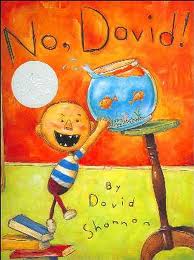
No David! By: David Shannon (1998)

"No, David!” by David Shannon is a children’s book that I will always hold dear to my heart. I have read this to my own son many times. When he was younger I would read it as “No, Jonny” instead of “No, David” as my son would act out the silly parts, and we would both laugh and laugh. David is a character that anyone can relate too. He is always getting into trouble, and like many children he is constantly hearing the word “No” Whether he is tracking mud through the house or banging on pots and pans, this little guy is always getting into something. At the end of the book David’s mother assures him everything is okay as she hugs him and says, “Yes, David… I love you!”
David Shannon’s mother found a collection of drawings that David had created as a child. The only words on those pages were “no” and “David”. These drawings inspired David to write and illustrate the first of the Diaper David books. “No, David!” This book was based off of David Shannon’s memories of his own childhood. The pages of “No, David” have very few words, but the pictures really tell the humorous story of young David.  In 1999, this book became a Caldecott Honor Book, because the pictures really bring the pages alive.
David Shannon was born in Washington, D.C. and grew up in Spokane Washington. He went to college at the Art Center College of Design in Pasadena California, and then moved to New York City. He currently lives with his wife in Los Angeles, California. (http://www.scholastic.com/titles/nodavid/davidshannon.htm, retrieved on February 8, 2011).

Genre: This book is fiction, although it is based on the author, David Shannon's childhood. This book could be used for character education in the classroom.
Theme: Following rules. Consequences. Cause and Effect.
Age level: 2 years and up
Pre-reading Activity: While sitting on the mat with a large group, discuss the cover with students. Talk about times when students have been in trouble. What happened when they got in trouble. How did this make them feel?
Post-reading Activity: Students should discuss the rules they know. What are the rules at home? What are the rules in the classroom? What are the rules in other places they spend time? Ask students why they think we have rules? Discuss safety.