Thank you for visiting my blog! I have been having a lot of fun creating these blogs, and I hope you enjoy reading about the books I've shared!
Showing posts with label Fiction. Show all posts

Tuesday, April 26, 2011

Lyle, Lyle, Crocodile. By: Bernard Waber. (1965).

I remember reading Lyle, Lyle Crocodile, by Bernard Waber when I was a child. I was reunited with the book a few years ago at one of my practicum sites. The students were in second grade and they were in their reading groups. They were listening to Lyle, Lyle Crocodile on headsets while they read along. The five students in the group were totally engaged. They all were smiling and visibly enjoying themselves. So of course, the first thing I did when I left the school was to head over to Barnes and Noble and buy a copy of Lyle, Lyle Crocodile for my son. He was only 3 or 4 at the time, but he liked the book. It was a little long for him, but he always enjoyed it for as long as a book could hold his attention. He's almost 7 now and we still read it from time to time. It is just one of those classics that kids are always going to enjoy. Who doesn't like to read about a crocodile who lives in an apartment in the city?!?

This book is about Lyle, a crocodile who lives in the city with the Primm family; Mr Primm, Mrs. Primm and their son Joshua. The Primm's neighbor, Mr. Grumps had a cat named Loretta that did not like Lyle, but in the end it was Lyle who saved Mr. Grumps and Loretta. Lyle has many fun adventures in the city; shopping, and ice skating and all kinds of other fun activities! Not your average crocodile!

About the Author: Bernard Waber was born in Philadelphia, Pennsylvania in 1924. He was a staff Sergeant in the United States Army from 1942-1945. After he left the Army, he went to the Philadelphia College of Art and graduated in 1951. He started writing in 1962.
Genre: Fiction, humor, character education

Theme/Skill: Be positive and kind. Treat others the way you want to be treated. Be a good citizen

Grade Level: K-4

Pre-reading Activity: Discuss with the class what it means to be a good citizen and a good neighbor. Discuss how it makes you feel when you see someone who is not being kind and not being a good neighbor. Have students discuss as well. 

Post-reading Activity: Lyle is the hero. Mr. Grumps announces that Lyle is the bravest, kindest, most wonderful crocodile in the whole wide world. He did not always feel this way about Lyle. Discuss in partners a time when you decided something about someone before you knew them. When you got to know them, did you find out they were different than you thought? Did you find out you had more in common with them than you thought?

Chicka Chicka Boom Boom. By: Bill Martin, Jr. and John Archambault. Illustrated by: Lois Ehlert. (1989).


Chicka Chicka Boom Boom, by Bill Martin Jr. and John Archambault is a children's classic. What a great story about the letters of the alphabet. Children can learn and practice the letters of the alphabet as they come alive playing around the coconut tree. This is a must read for all preschoolers and children in kindergarten. This story is told in a beautiful rhythm that any child would enjoy. Great book!! My son is a little old for it now, but when he was younger, he loved it!! Now I read it with my daughter who is 21 months and learning the alphabet, and she loves listening to it.

About the Author: Bill Martin Jr. was born in 1916 and died in 2004. He wrote children's books for almost 60 years. He wrote his first book, The Little Squeezy Bug: The Story of the Firefly in 1945. He wrote over 300 books including Brown Bear Brown Bear What Do You See, which was illustrated by his good friend Eric Carle. John Archambault wrote this along with Bill Martin Jr, and the duo wrote a number of other books together.

 
Genre: fiction, letter awareness

Theme/Skill: Letter recognition and awareness.

Age Level: 2yrs-6yrs.

Pre-reading activity: Students should recite their ABC's. Then in circle time, students should use picture/letter flashcards to identify words that begin with each of the letters of the alphabet.

Post-reading activity: Students should predict what is going to happen next. What order will it happen in? Who will come after a on the race to the top of the coconut tree (and so on...).

The Berensteain Bears and the Trouble With Friends. BY: Stan and Jan Berenstain. (1986)

The Berenstain Bears: Trouble With Friends, by Stan and Jan Berenstain was one of my favorite books growing up! Who doesn't love the Berenstain Bears; I think I had them all (that were published at the time). This one was one of my favorites, probably because I was a bossy little girl myself, much like Sister and Lizzie Bruin in this book. In this book, Sister Bear is sad because Brother Bear is always off playing with Cousin Fred, and his other friends, leaving Sister Bear to play by herself. Then one day, she sees a moving van down the road. A new girl cub was moving in... Lizzie Bruin. Lizzie and Sister became the best of friends right away. Then Sister went over to Lizzie's to play school. Both Lizzie and Sister thought they should be the teacher. They got in an argument and Sister left. Later on, Lizzie came by and Sister and Lizzie made up. This is a cute story about childhood friends, who may not always get along, but learn that they should compromise with one another to keep each other happy.

About the Author: Stan and Jan Berenstain started drawing together when they met in Miss Sweeny's drawing class on the first day of art school at Philadelphia Museum School of Industrial Art (now called The University of the Arts) in 1941. Stan went into the Army in WWII, and shortly after his return home, Stan and Jan married. They raised two sons, Mike and Leo. In 1962 then introduced the Bear Family in The Big Honey Hunt. Since 1962, they have created over 300 Berenstain Bear books. In 2005, at the age of 82, Stan died, but Jan and her son Mike continue to write Berenstain Bear books.

Genre: fiction, character education.
Theme/Skill: Character Education: How to be a good friend. Compromise with your friends so that you can both be happy. Take turns, and do what others want also (within reason).
Age Level: 2yrs-7yrs.

Pre-reading activity: Students should talk about the importance of being a good friend. What makes a  good friend? What makes you think someone is not a good friend? Class discussion.

Post-reading activity: Students should write something they like to do with their best friend and they should draw a picture of themselves with their best friend playing together.

My Sister, Alicia May. By: Nancy Tupper Long. Illustrated by Shennen Bersani. (2009)

I really enjoyed reading My Sister, Alicia May, by Nancy Tupper Long. It is a story about a girl named Rachel, and her sister, Alicia May who has Down Syndrome. Alicia May is a very friendly, very lovable little girl. Rachel discussed that Alicia May is a lot like other kids; she likes dogs and horses, and she loves to paint her toenails and watch for bugs, especially ladybugs. Rachel does not always play with Alicia May, because she has her own friends. Sometimes Alicia May really annoys Rachel, some days Rachel is really sick of watching out for Alicia May. But by the end of the book Rachel says to her mama, "I wish everyone had an Alicia May. But then Alicia May wouldn't be special would she?" Rachel loves Alicia May, she loves her for who she is, she loves her for all her differences, and even though Alicia May annoys her sometimes, she feels lucky to have someone like Alicia May in her life. I really loved this book. It was beautiful!

Genre: Special Needs, Character education
Theme/skill: We all have special talents and interests
Grade level:

Pre-reading activity: Teacher should talk about someone with special needs that they know. Maybe the person is in a wheel chair, maybe the person is deaf or blind, or maybe the person has Autism. Teacher should make a point of talking about the things that the person with special needs likes, just like any other kid. Ask students if they also like these things. Its important for students to feel like they can relate people with special needs. It makes them seem less different.

Post-reading activity: Students should be assigned to work with a student that they do not always work with/ are not close friends with. Students will interview their partner to find out their partners special interests, what they like to do on the weekend, what their favorite foods are, what they are scared of, etc. Students should then present their partner to the class. This is a  great way for students to learn about one another.It's a great community builder!

Nancy Tupper Ling won the Writer's Digest Grand Prize and the Pat Parnell Poetry Award. She lives in Walpole, Massachusetts, with her husband Vincent and their two daughters.

Monday, April 25, 2011

Alexander Who Used to Be Rich Last Sunday, by Judith Viorst. (1978)


In this story, Alexander's grandparents give him a dollar. He starts to spend his money right away, seven cents here, twelve cents there, and before you know it, Alexander who used to be rich, is out of money.
Alexander, from the Alexander series written by Judith Viorst has got to be one of my all time favorite child characters in literature. I actually added two books about him to my blog because I think there are so much you can do with them. I actually did a character education lesson with Alexander Who Is Not (Do you Hear Me? I Mean it!) Going to Move, during my student teaching also at the beginning of the year when we had three students who had just moved into the area. That book and lesson was also a big hit with students.
Alexander is always a big hit because he is your average kid, he has two brothers, an eye for mischief, and there is always something going on with him. In these stories there is always a good lesson, and in this particular story, Alexander Who Used to be Rich Last Sunday, I would use it as a way to show kids how fast you can spend money, and as a math lesson. I used this while student teaching in second grade while we were working on money. I gave students a money mat, and plastic coins that added up to a dollar. As Alexander spent seven cents, the kids would remove a nickel and two pennies from there mat. By the end of the story, they had no money left... Just like Alexander. This story is a lot of fun, and it was such a great tool for a hands on math lesson. Kids were really into it. 

About the Author: Judith Viorst was born in 1931 and brought up in New Jersey. She has lived in Washington D.C. since 1960 since she married her husband, Milton Viorst. She has three sons, and I was surprised and excited to learn that their names are Anthony, Nick and Alexander, because those are the names of the brothers in the Alexander series. She writes science books, children's picture books, adult fiction and non fiction, poetry for children and adults and she has also written three musicals.

Genre: Learning about money, fiction

Age Level: 4-8

Theme/ Skill: Students will have a dollar, and subtract different amounts while following along with the story, until they, like Alexander have spent all of their money.

Pre-reading activity: (2nd grade) Before reading students will be given plastic coins to practice making different dollar amounts. They learned coin values in first grade, and they will have a review of the coin values before this lesson. They will practice adding coins together, and subtracting different amounts.

During reading:  Students will use plastic coins while they read along with the story. Students have a dollar worth of plastic coins on their money mat. They will subtract coins when Alexander spends a certain amount. They will record how much he spent, and how much he has left. When the story is over, the students be out of coins on their money mats, and Alexander will have spent his dollar.

Post-reading activity: There will be a mock store in the classroom. Students will have a certain amount of coins, and they will be able to spend their coins on different items in the store. Students will try to spend all their money on objects in the store without having any change left.


Teach Us, Amelia Bedelia. By: Peggy Parish. Illustrated by Lynn Sweat. (2004)

Amelia Bedelia is one of my all time favorite characters. She is such a sweet person, she always has the best intentions, but she will take everything that you say literally, and she doesn't seem to understand that words or phrases can have more than one meaning (colloquial). The situations she gets herself into will make anyone laugh. These books are also a great way to teach children about colloquial words. Many times children will not know what calling the roll is, or being a hand at singing, so this can open them up to more of our language that they may not hear everyday. Readers should use the illustrations to figure out what Amelia should be doing, and what Amelia actually ended up doing. In Teach Us, Amelia Bedelia, Amelia is mistaken as the new substitute teacher, and the laughs never end as she attempts to follow the days lesson plans. I have read this book so many times, and I still keep laughing. I read this with reading groups during my student teaching, and had a lot of fun with it, because I was having my own new teacher experience, so I could really relate to Amelia! It was a lot of fun!

About the Author: Peggy Parish

Genre: Humor, Fiction
Theme/Skill: Understanding synonyms and colloquialisms. Amelia Bedelia takes everything literally; read along to find out what Amelia Bedelia will do next and use the pictures to see what she is up to.
Grade Level: Kindergarten-3rd grade
Pre-reading activity: Have a reading group discussion on synonyms and  colloquialisms. Give students examples of words that have multiple means. Teach children to use context clues, and clues from the illustrations to understand which meaning of the word in intended. Give examples.

Post-reading activity: Students will work in a small group to review the book and to make a list of examples in which Amelia Bedelia misunderstood the meaning of something. Then give students a t-chart and on each side it should say "Amelia Bedelia calls the roll". Students should draw a picture on one side of what Amelia Bedelia was supposed to do, and on the other side draw a picture of what Amelia Bedelia thought she was supposed to do

Tuesday, April 19, 2011

Crocodaddy. By: Kim Norman. Illustrated by: David Walker. (2009)

Crocodaddy, by Kim Norman is a cute story about a little boy that is swimming with a crocodile, and he is the crocodile hunter. Only its not really a crocodile, its the crocodaddy. Its a really sweet story about a boy that is having a fun afternoon with his daddy. I love this story. I think of all the fun my son has with his daddy. Its a lot of fun to watch as Daddy becomes a child again while he plays with his little boy. While I am reading I can picture my husband as the Crocodady, and my son as the little boy. I love reading this book with my son, Jonathan, and he loves it too. He has such a special bond with my husband, and whenever there are stories or songs about a daddy and his little boy, my son gets really into it. It is so adorable!

Genre: fiction, humor
Theme/Skill: Family is important. Having fun with family
Grade Level: PreK-2

Pre-reading activity: Students should discuss in small groups activities they like to do in the summer. Do they like to go to the beach? On a hike? On vacation some place in particular? Students should then draw a picture of themselves doing their favorite summer time activity.

Post-reading activity: During rug time students will add to a family word web. They should talk about the best memory they have with someone in their family and it should be added to the word web. After students will go back to their seats and write about their special memory.

If You Give a Mouse a Cookie. By: Laura Numeroff. Illustrated by: Felicia Bond (1985)

I love the Mouse a Cookie series. We have every book in my home. We even have the  Mouse, Cookies and More Treasury,  which includes "If You Give a Mouse a Cookie", "If You Give a Pig a Pancake", "If You Give a Moose a Muffin", "If You Take A Mouse to School", and also games, recipes and songs that go along with the stories. The Treasury also comes with a CD so that children can listen and read along at the same time, and listen to the songs. It is so cute!
If You Give a Mouse a Cookie, is definitely my favorite of the series. I've read it so many times in my life that I think I can recite the book, without even looking at it. The book starts with "If you give a mouse a cookie, he'll ask you for a glass of milk..." and the book ends with "And chances are, if he asks for a glass of milk, he's going to want a cookie to go along with it".

Genre: Fiction
Theme/Skill: Students will practice cause and effect relationships. Students will also practice putting things in sequential order.
Grade Level:PreK-2

Pre-reading activity: Students will be working on sequential order. They will read scrambled directions on how to make cookies, and they will put them in order. (The directions will be simple like start the oven, cook the cookies in the oven, turn off the oven, etc).
Post-reading activity:  Students will cut out different lines from the book on a worksheet. They will have to decide what causes what. For example, 'If you give a mouse a cookie' will go before 'he'll ask you for a cup of milk'. Students will decide the order based on what they just read. Students will also be able to go back and read the book again to check their work!

The Kissing Hand. By: Audrey Penn. Illustrated by: Ruth E. Harper and Nancy M. Leak. (1993)

At my son's kindergarten orientation, his new kindergarten teacher gave each child, The Kissing Hand  by Audrey Penn. I had never read that book before. We took it home and read it, and it became totally clear why this was handed out to children going into kindergarten. In the story, Chester Raccoon does not want to go to school. He wants to stay home with his mommy and play with his friends, and play with his toys and play with his friends, and read his own books and swing on his swing. His mother explained to him that sometimes we do things we don't want to do, even if they seem scary at first. And she assured him that he would love school, once he started.She told him he would make new friends, and play with new toys and read new book, and swing on new swings. Then she taught Chester about the Kissing Hand. She kissed the palm of his hand, and told him that whenever he feels lonely and needs a little loving from home, he could press his hand that she had kissed to his cheek and think 'mommy loves you. mommy loves you'. And she said that kiss would jump up to his face and hill him with toasty warm thoughts. Before Chester went to school his mother kissed his hand, and then Chester surprised his mother and kissed her hand too, so she would also have a kissing hand. Then Chester happily ran off to school.
I loved this book! I actually read this again to Jonathan the night before his first night of kindergarten, and before he left we did the kissing hand together. It was adorable, and he got right on that bus, and was a big boy and went to school. I don't know if the kissing hand actually helped Jonathan, but it was definitely a special moment on his first day of kindergarten! So cute!!

Genre: Fiction, character education, first day of school.
Theme/Skill: Students will learn that it is okay to leave home and go to school. Its okay to try new things, even if your scared, because you may learn that you like it!
Grade Level: PreK-2

Pre-reading activity: How did you feel on your first day of school? Have a class discussion about students' feelings on the first day of school.

Post-reading activity: Write a letter to Chester telling him what he will like about school.

The Snow Bear. By Miriam Moss. Illustrated by: Maggie Kneen.

The Snow Bear is a special book in my house. We always read it during the Christmas holidays. Jonathan loves it, and it's something I love to read. This year, at Jonathan's first grade classroom Christmas Party, I read The Snow Bear to his class. All the kids loved it, and many of them told me they also had this book at home, and liked to read it in the winter time.
The Snow Bear by Miriam Moss is a beautiful story about a little polar bear cub who is looking for his mother. He gets help from other animals as he looks. The animals help him build a snow bear. In the evening, all the other animals' mothers call them to come home, but not the little white bear cubs. He goes to sleep with the snow bear, and when he wakes up, his mother has found him. Its a beautiful story, and the picture by Maggie Kneen really help bring this story to life.

Genre: Fiction, character education
Theme/Skill: Be a good friend. Help others
Grade Level: PreK-2

Pre-reading activity: Small group discussion: Have you ever lost something very important to you? How did this make you feel? Did you ever find it? How did you find it?

Post-reading activity: The little bear lost his mother,and his friends helped him build a snow mother. He must have some great friends. What are some things you think would make a great friend? Students should have a copy of a word web. They should work with a partner to fill in what are characteristics of good friends.

Junie B. Jones: Is a Graduation Girl. By Barbara Park (2001)

I was introduced to Junie B. Jones while I was student teaching in second grade. We read a couple of chapters of Junie B. everyday after recess to get the students calmed down and back into school mode. I fell in love with the adorable five year old! One thing I learned about Junie B. is that you never know what she's going to do or say. I chose to put Junie B. Jones Is a Graduation Girl in my blog, because its the end of an era. This is the last of Junie B.'s adventures as a kindergarten student. The next book starts first grade.
In this book, Junie B. is so excited about her graduation from kindergarten. Mrs., her teacher gives each student a white cap and gown that they will need to bring home, and wear to school on the graduation day. She tells the students not to play with them, and to keep them safe. Well, of course, Junie B. cannot handle knowing that beautiful cap and gown are sitting there in a box in her house and she cannot touch them. If you know Junie B., you can just imagine what happens next! Everything works out in the long run, but there are a lot of laughs along the way.
Junie B. is such a great character for young children developing a love for reading. My son will read these books on his own, but we really enjoy reading Junie B. together before bed. Story time before bed is one of my favorite moments with my kids, and Junie B. always makes it even more enjoyable

Genre: Fiction, humor, character education
Theme/Skill: Getting ready for graduation/ moving from one grade to the next.
Grade Level:1-3

Pre-reading activity: Students will discuss what they felt like when they graduated from preschool/kindergarten/first grade, etc with a partner. Were they happy? sad? scared? excited? confused? And why did  they feel this way. They will share with the class how they felt.

Post-reading activity: Junie B. was ready to go to first grade, but things were going to be different for her next year. What can you tell Junie about the first day of first grade was like for you? What did you like best? Seeing old friends? Meeting new friends? School lunch? Write Junie B. a letter about what you think she is going to like best about first grade.

Hedgie Blasts Off! By: Jan Brett (2006)

Jan Brett is one of my favorite children's authors. Her stories are always so beautiful and they really come to life. Hedgie Blasts Off , is no different. Hedgie wants to be an astronaut. He has never flown in a spaceship but he takes care of  the Zeppadoppler rocket for the professor who is the smartest scientist on earth and who is also in charge of Outer Space. Finally, as chance would have it, there is a problem, and Hedgie is the only one who can fit into the rocket, and he gets his chance to go into Outer Space. Zoom! Hedgie blasts off! Hedgie has an exciting adventure in space, and when he returns home, he is surprised with the Official Astronaut Star for his courage and cool thinking from the Professor. He was now a real astronaut. "Three cheers for Hedgie! Hurray!"
This is another book I love to read with my son. We have a collection of Jan Brett books. I think Gingerbread Baby is my favorite, but I know that Hedgie Blasts is definitely Jonathan's favorite! Its such a fun story, and its perfect for children who like to read stories about Outer Space!

Genre: Fiction, Space
Theme/Skill: Never Giving up on our dreams.
Grade Level: K-3

Pre-reading Activity: Students should discuss what they want to be when they grow up with partners, and then share it with the class. Why do the students want these jobs? What makes these jobs interesting?

Post-reading Activity:  Hedgie finally got to go to space and become a real Astronaut. Students should write in their jouirnals about a time when something felt impossible, but they kept trying and did it anyway.


Froggy Gets Dressed. By: Jonathan London (2002)

I wish that there were Froggy books when I was a child. They are so funny! We have five or six of the Froggy books by Jonathan London, and they really are all very funny. My favorite is Froggy Gets Dressed. I don't know if this is my favorite because this is the cutest one, or if it's because I LOVE my son's reaction every time I read this. I do the voices of Froggy and his mother, and it leaves Jonathan laughing hysterically every time.
Froggy wants to go out and play in the snow, he will start to get dressed and then head outside, and then his mother will yell "Froggggggggggggggggggggyyyyyyyyy" and he'll yell, "Whhhhhaaaaatttttttttt?" and then his mother will tell him what he forgot to put on. Jonathan's favorite part is when Froggy's mother tells him he forgot to put on his underwear! But what first grader doesn't love the word underwear? Its just the funniest word to them! When my husband was the mystery reader for Jonathan's class (they give out clues about the reader to the kids every day, and then on Friday the mystery reader comes into the class) he asked me what I thought he should read to the class. I gave him Froggy Gets Dressed. When my husband got home, I asked him how it went, and he said that it was a huge hit, everyone laughed a lot, especially when Froggy forgot his underwear. He also said that Jonathan's teacher had never read that one before, and asked to borrow the book to bring him to read to her children. Definitely a cute book! I recommend to anyone looking for a fun book to read to children.

Genre: Fiction, humor
Theme/Skill: Students will work on putting things in sequential order.
Grade Level: PreK-2

Pre-reading activity: Students will write in their journals about what they like most about playing in the snow, and what they like to do the most while they are playing in the snow.

Post-reading Activity:  Students will have a doll, and they should first dress them in their shirt and pants, and then their jackets, and then their hat and gloves and scarf. Students will race with a partner to see who can get the doll dressed correctly the fastest, without leaving anything out!

Tuesday, February 8, 2011

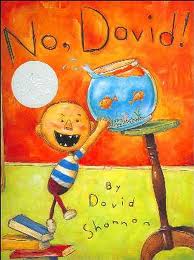
No David! By: David Shannon (1998)

"No, David!” by David Shannon is a children’s book that I will always hold dear to my heart. I have read this to my own son many times. When he was younger I would read it as “No, Jonny” instead of “No, David” as my son would act out the silly parts, and we would both laugh and laugh. David is a character that anyone can relate too. He is always getting into trouble, and like many children he is constantly hearing the word “No” Whether he is tracking mud through the house or banging on pots and pans, this little guy is always getting into something. At the end of the book David’s mother assures him everything is okay as she hugs him and says, “Yes, David… I love you!”
David Shannon’s mother found a collection of drawings that David had created as a child. The only words on those pages were “no” and “David”. These drawings inspired David to write and illustrate the first of the Diaper David books. “No, David!” This book was based off of David Shannon’s memories of his own childhood. The pages of “No, David” have very few words, but the pictures really tell the humorous story of young David.  In 1999, this book became a Caldecott Honor Book, because the pictures really bring the pages alive.
David Shannon was born in Washington, D.C. and grew up in Spokane Washington. He went to college at the Art Center College of Design in Pasadena California, and then moved to New York City. He currently lives with his wife in Los Angeles, California. (http://www.scholastic.com/titles/nodavid/davidshannon.htm, retrieved on February 8, 2011).

Genre: This book is fiction, although it is based on the author, David Shannon's childhood. This book could be used for character education in the classroom.
Theme: Following rules. Consequences. Cause and Effect.
Age level: 2 years and up
Pre-reading Activity: While sitting on the mat with a large group, discuss the cover with students. Talk about times when students have been in trouble. What happened when they got in trouble. How did this make them feel?
Post-reading Activity: Students should discuss the rules they know. What are the rules at home? What are the rules in the classroom? What are the rules in other places they spend time? Ask students why they think we have rules? Discuss safety.